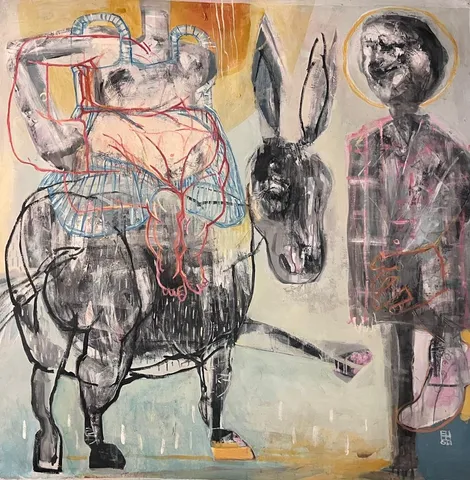
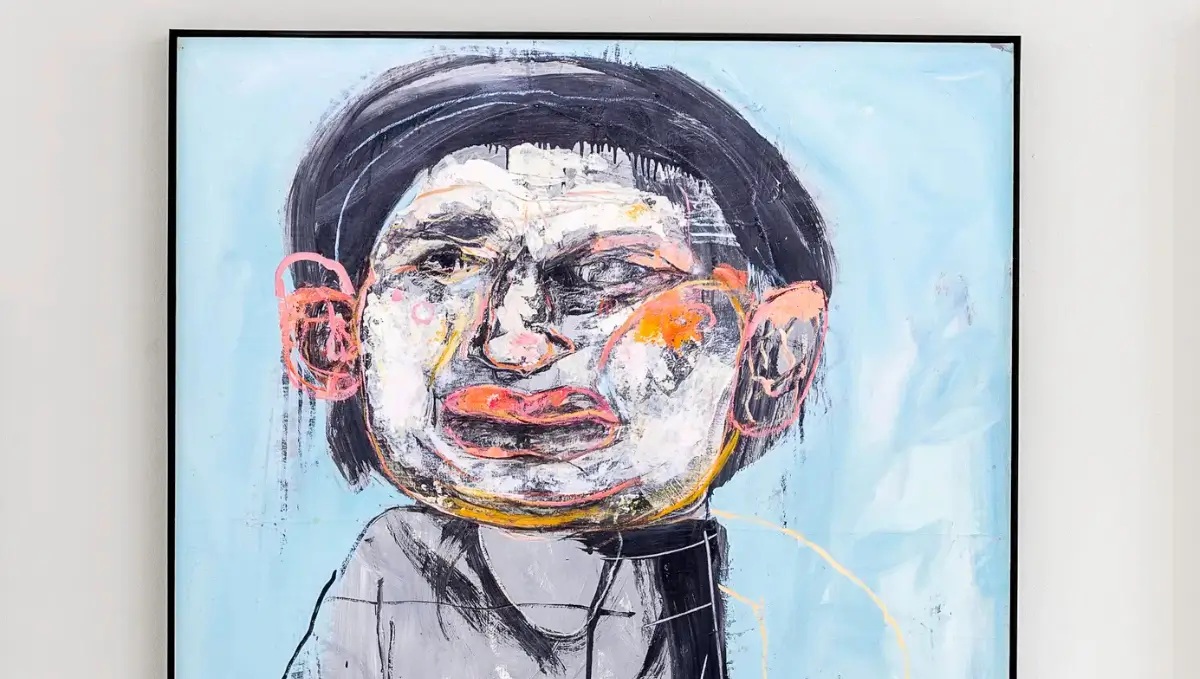
In Unquiet Figures, Eulogia Merle moves between human portraiture and animal imagery without treating either as fixed categories. Women, men and children appear alongside horses, cats, zebras, elephants, rhinos and panthers; elsewhere, human and animal characteristics begin to overlap.
Works such as Woman, Horse, and the Moon, Boy and Cat, Woman Panther, Elephant and Zebra show Merle using distortion as part of the image rather than something to be corrected. Faces shift, bodies are abbreviated and proportions refuse to settle. Acrylic colour, line and gesture remain visibly active, giving the paintings a restless physical quality.
The animals are not simply companions to the human figures. They introduce another register – instinctive, watchful, protective or unpredictable – and often alter the emotional charge of the work around them.
That becomes particularly apparent in pieces such as Woman Panther II, where the distinction between person and animal is no longer entirely secure. The interest lies less in transformation as spectacle than in what happens when familiar categories begin to loosen.
Merle’s figures can be tender, awkward, humorous or confrontational, sometimes within the same painting. Their irregularities are left exposed rather than polished away, giving the work a sense of immediacy and making straightforward readings difficult to sustain.
As Merle describes it:
“These figures do not sit quietly within the canvas. They emerge, retreat and resist definition, moving between the human and the animal, the familiar and the strange. Unquiet Figures is about that restless space, where instinct, vulnerability and identity refuse to remain still.”